3D Printing Simple Machines (Part 1: Pulley)

Updated My Journal
I want to push what I can do. Designing storage solutions for my home & garage has been great. It’s also been cool to be able to make model buildings, deck holders, pen clips, and all sorts of useful things. One thing that I really liked making though was my Lazy Susan. A wheel that could actually spin was a Pretty Big Deal to me.
A Lazy Susan is basically a disk with evenly spaced holes in it, like an orderly Swiss cheese, sandwiched between a base and a surface that actually rotates. You put tiny balls in the holes before sandwiching the lot, and the balls are sized just so that they touch both the surface and the base. The ensemble is held together by a shaft in the center that the disks rotate around, and the balls will spin when you try to move the surface plate, poof, a rotatable surface.
Making a working one was positively gratifying, and I used my newfound knowledge to create and 3D-print a rotating goblin fort, which was a great battlefield addition at our next gaming session. What an awesome use of the wheel and axle.
What else could I do or make with basic machines? Come to think of it, what were they again? There was the wheel, the lever, the pulley, and some other things. Eep. Time for a refresher!
Simple machines, or basic machines, have few or no moving parts, and these creations make work easier by changing the direction or amount of force applied.
According to TeachEngineering.org, there are six types of simple machines, and it seems the wheel isn’t the only one I’ve already used! There are the pulley, screw, lever, wedge, wheel & axle, and inclined plane.
I 3D printed some screws for one of my storage trays, and completely forgot that screws were even a simple machine. I’ve already used a third of the existing types in my prints!
Now to give the machines a good look, while letting some ideas percolate for how I might use these beauties in future projects.
The Pulley
The first one in the list is the pulley. A pulley is a disk with a cable round it, and when you put weight on one end of the cable, it becomes easier to lift the other end up. I’m going to make one of these to lift my phone up! I need a little guidance though, as I don’t know where to start. Fortunately, KID Museum has a youtube video walking me through the process.
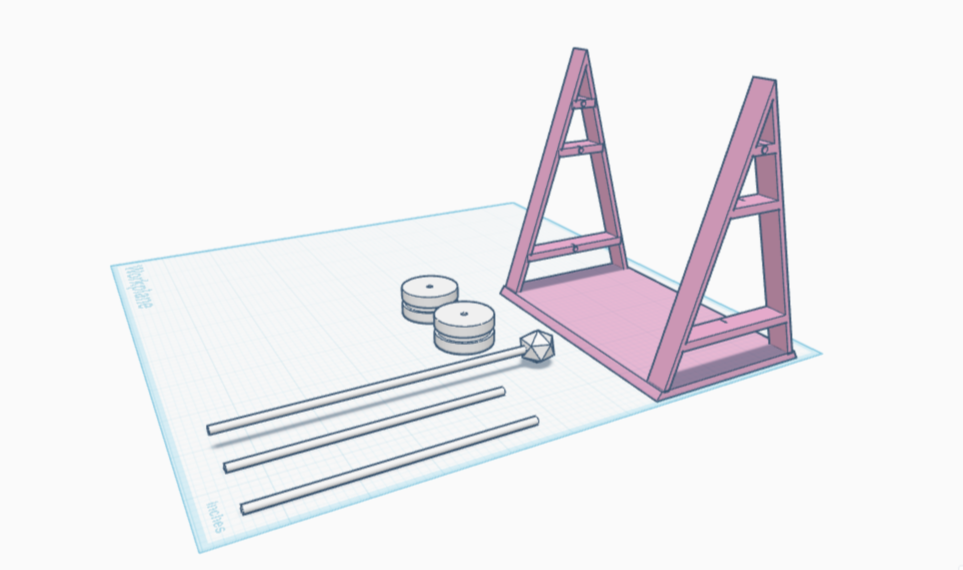
For this project I’ll need a spool, a pole that the spool can slide onto and spin around, and some thread. I’m also going to need some scaffolding to support the pole.
Because the pulley changes the direction the force is applied, we will now pull something down to lift something up, instead of just lifting it up! The same amount of force is needed, but we have a lot more force at our disposal since we can now use our whole body weight. The phone should be an even easier lift. (!!)
I printed it, and it was super cute! But would it be effective? Time to find out!
I wrapped a piece of string around one of the wheels, then placed that on the axle slotted near the top of the scaffolding. I tied my phone to the other end of the string, but the axle was too thin and the scaffolding too weak to hold it.
I then threaded two wheels side by side on the same axle, expecting and receiving no advantage. After all, the single pulley is meant to change the direction of force. Adding more wheels shouldn’t make it go in the opposite direction even harder, and one wheel alone wouldn’t change the heaviness of the phone. Still, this was a chance at experimenting, so try I did, and of course the phone was still too heavy.
Having multiple wheels on different axles turns a single pulley into a compound pulley, and is useful for lifting heavy objects. A compound pulley distributes force equally across multiple ropes, reducing the amount of force needed to lift something.
Creating a compound pulley by splitting the wheels so that they used two different axles was the next obvious step, but alas the other two axles weren’t long enough to fit the scaffolding. I’ll have to reprint them and try this particular experiment again later. When I do, I’ll reprint the scaffolding too. This one worked, but it wasn’t very strong.
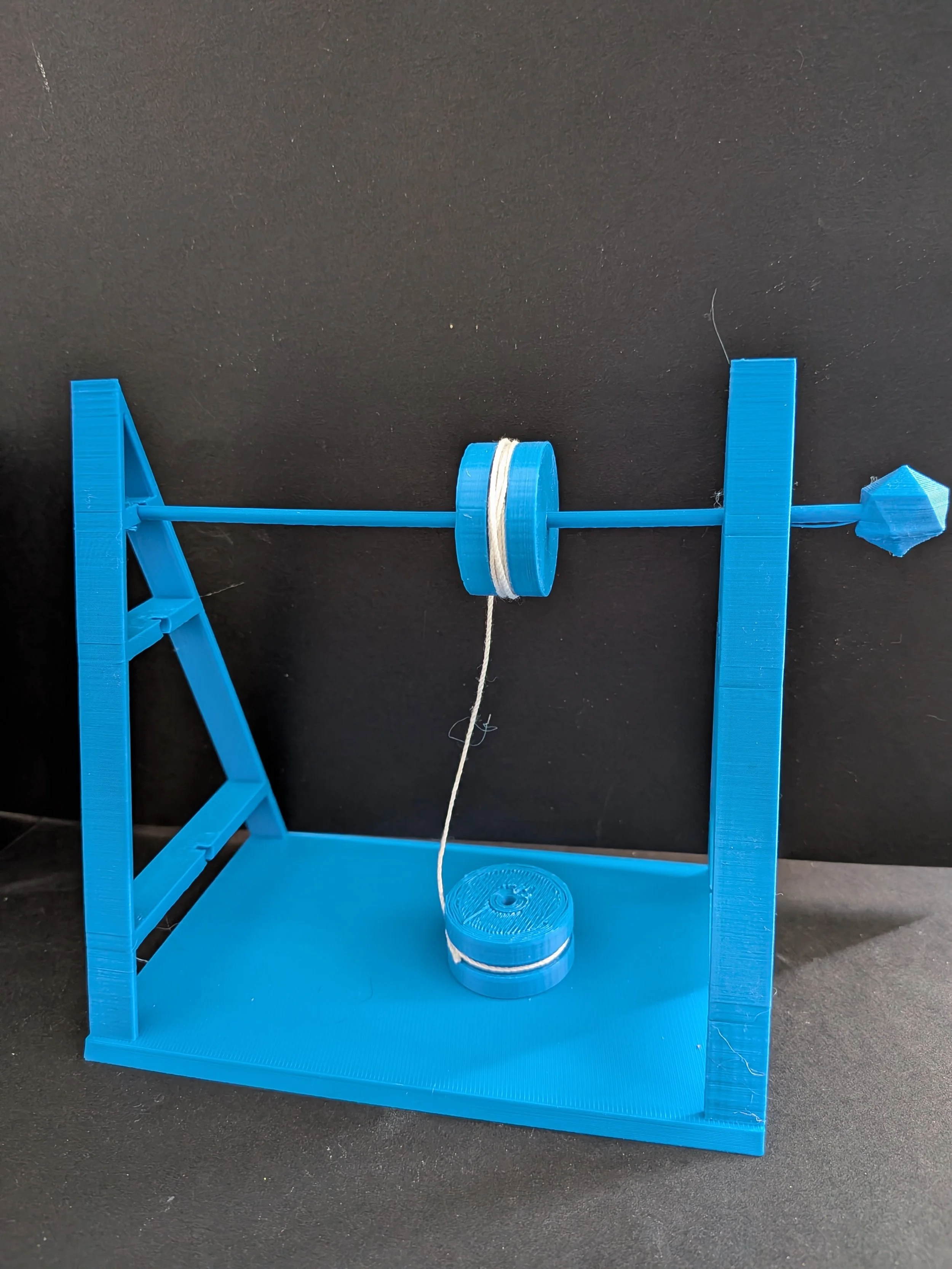
I next tried the setup with one wheel on the axle, using the other wheel as a weight. I ran the end of the rope through the hole in the spare wheel and tied it on. I was able to lift the spare wheel by turning the crank, and that seriously made my day. I started imagining all the things I could do with such a setup. Then realized I was daydreaming and needed to get back to this article - I’ll save those ideas for another time. Meanwhile, here is the pulley and scaffolding setup: