Same File, Different Fit: Testing Printers and Filaments (Part 2)
White Filament Specs
And Now We Play
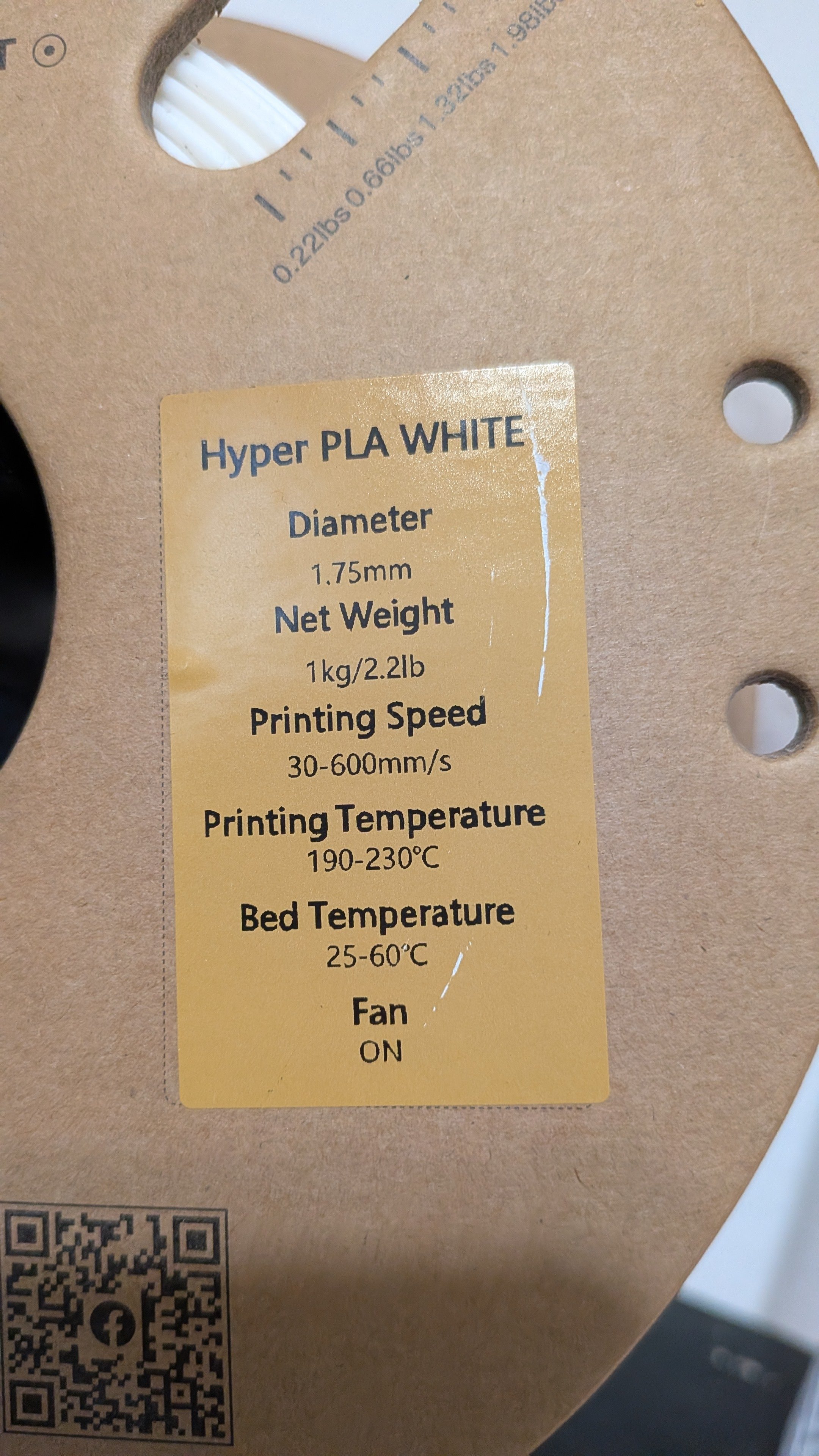
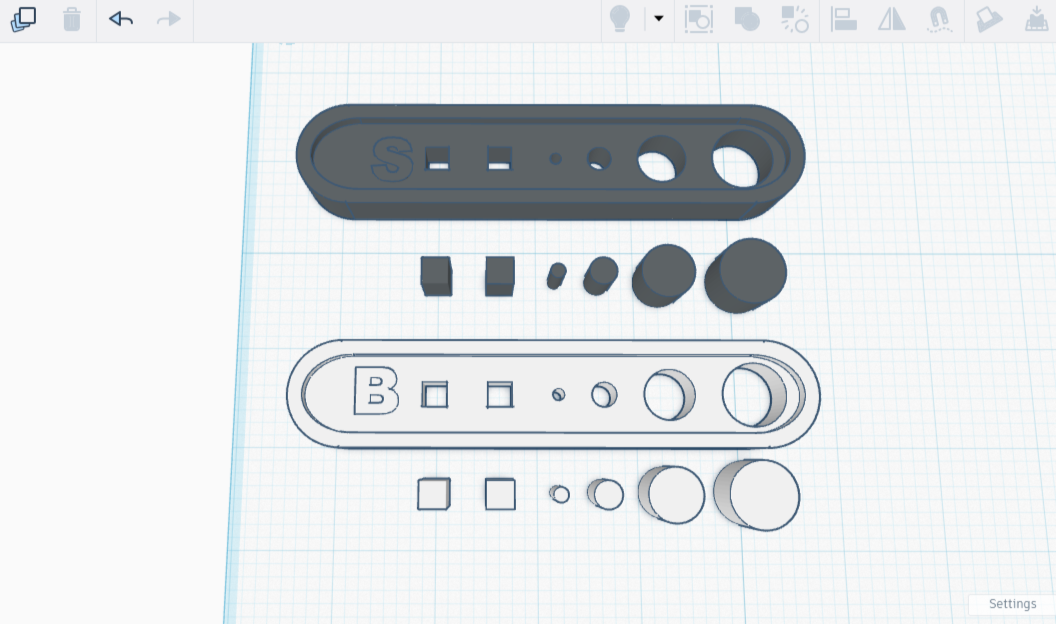
It's time for an experiment! I had a nice dark grey filament and a white filament. To run a test, I thought to try out different types of holes, to see how shapes fit in them on different printers. I posted the specs for the white filament in the image to the right (above if you're viewing this on a phone). The grey filament is an unknown. I think it's PLA basic, but someone threw out the box, so it's anyone's guess. I went to Tinkercad, where I created a special shape to test this out: a long oblong with different shaped and sized holes cut out along its length, and either an 'S' or a 'B' added in raised script to one end.I then created some shapes, enough to fit each hole. I’m not sure why I printed both squares at a quarter inch, but I realized what I had done only after playing with the finished sets.
Testing Kit
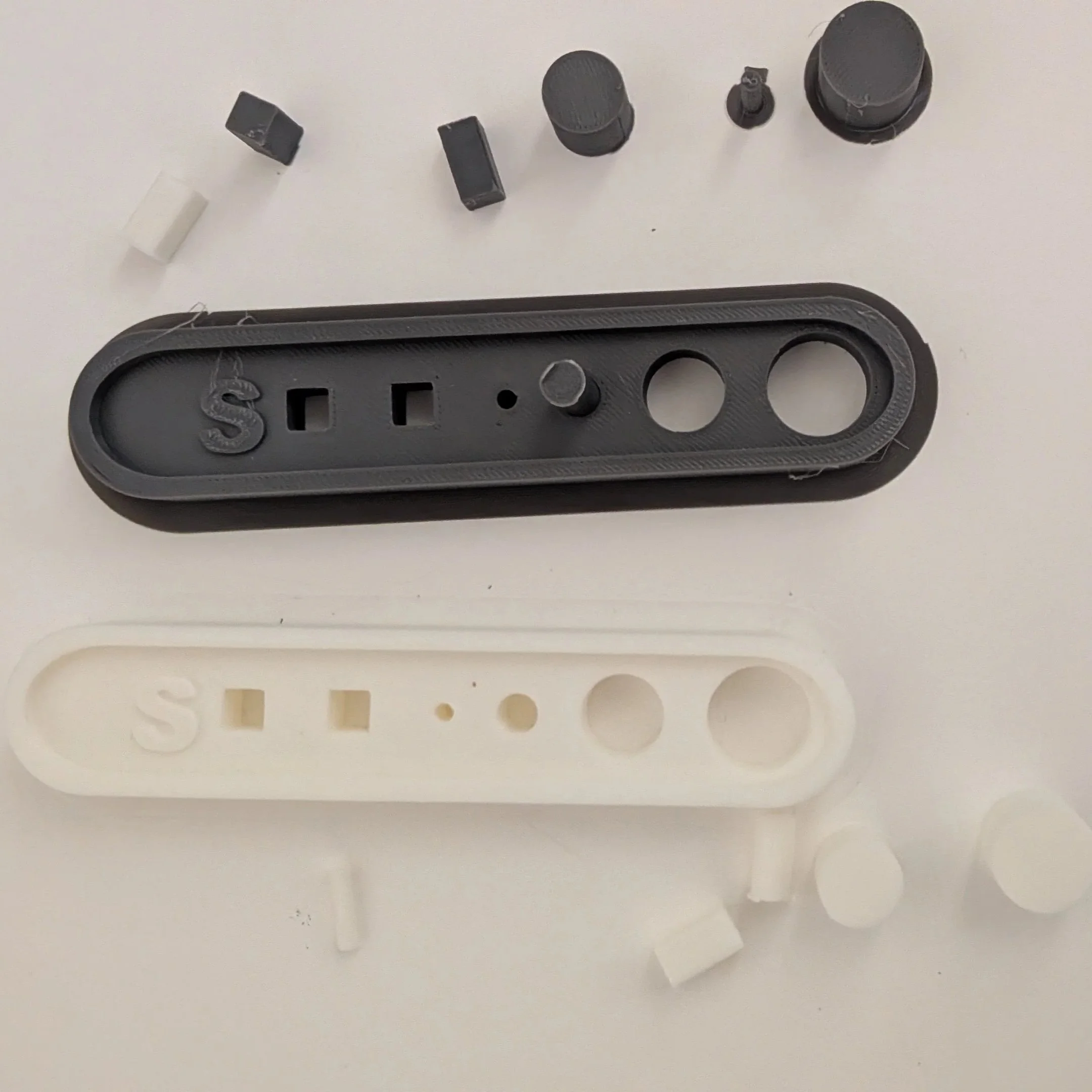
Both Pieces Printed on the Sovol
Even one square was enough to notice something interesting: one grey square could, with effort, slide into one white one and both grey holes, and the other could slide into one white and one grey. It took finessing and sheer stubbornness to get either into the white slot, though mere finessing was enough to get them into the grey.
On the other hand, no white square fit in any grey ones. I wonder what the result would have been with half-inch squares.
On to the circles!
I had holes from 1/16th of an inch to ½ an inch. No pegs fit in either 1/16th inch hole, the grey 1/8 inch peg fit in the grey hole but not the white, no pegs fit in the ¼ inch holes, and the grey ½ inch peg fit in both the grey and white spaces.
Again, no white pegs fit in any spaces.
I put the Sovol-printed pieces in a bag and set it aside, then got out the ones printed on the Bambu.
Sovol 3D-Printed Test Parts!
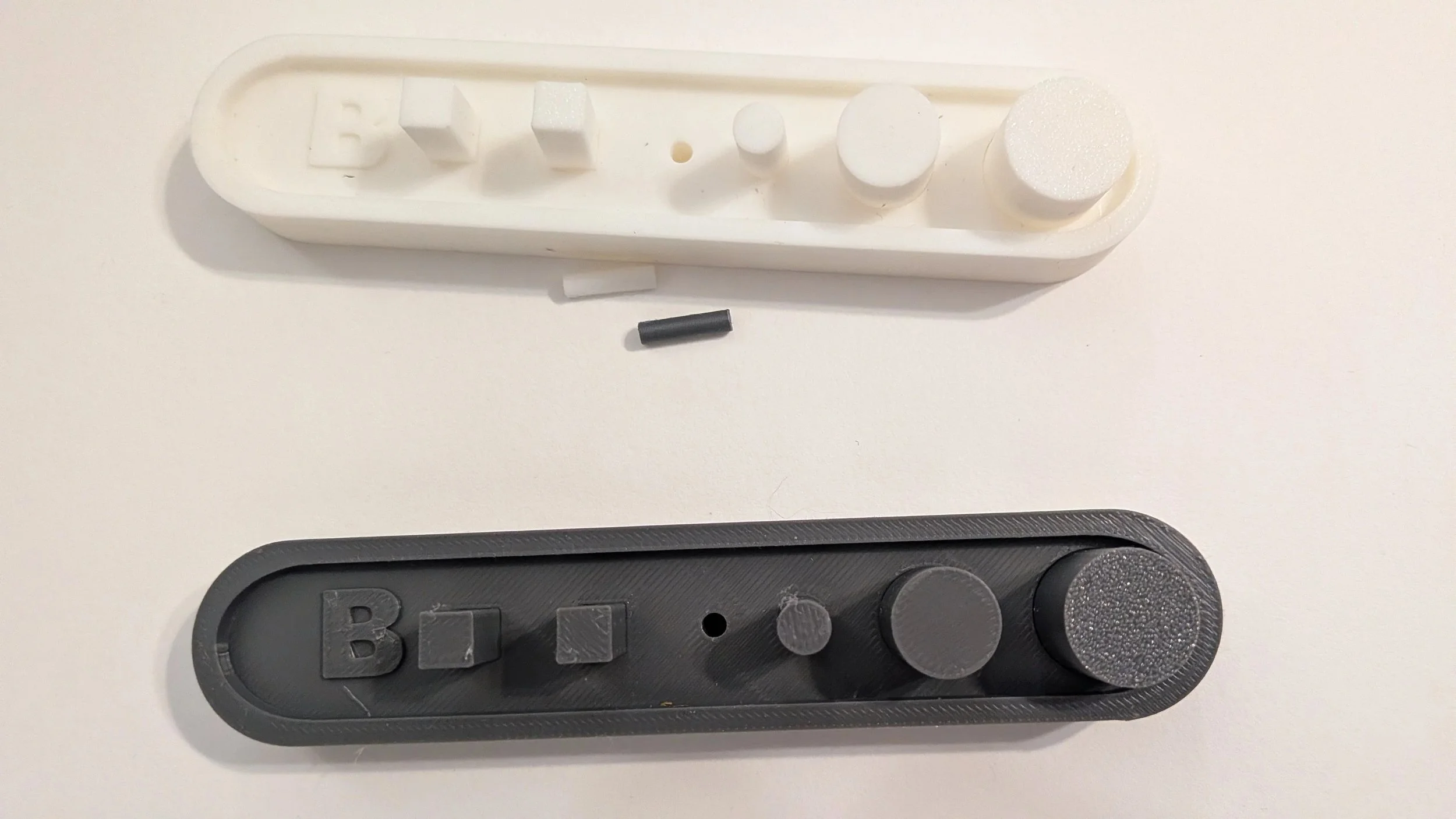
Both Pieces Printed on the Bambu
I absolutely did not expect that outcome! Everything fit in both the grey and the white slab, except for the 1/16th inch pegs, which fit in neither. Switching them out, the white fit in the grey and the grey into the white interchangeably, though putting the grey squares into the white slab hurt my fingers. I also think the grey slid more easily into the white in general, but it's hard to say.I don’t know what to make of this. It might be a matter of settings, though my family does prefer the Bambu for finer prints (which again might be a matter of settings). Perhaps we’ll get more information with the final test.
Bambu 3D-Printed Test Pieces!
Base Printed on Bambu, Pegs on the Sovol
I started with Sovol pegs and a Bambu base. I am not sure what to expect. Because the bambu seems to be a tighter printer, I expect it to fit better. I don't know how much that can offset the apparent less precise print. My best guess: the bambu pegs fit better into the sovol holes, but i don't know that any sovol-printed pegs will fit in bambu holes. Time to find out!First, the round pegs. The grey ½ inch pegs fit in both grey and white. The white ½ inch also fit in both, though it got stuck in the white board. The grey ¼ inch peg fit in both holes, though it hurt my fingers to get it in the white board. The white ¼ inch peg fit in neither. The 1/8th inch grey peg also fit in both, though the white board was a tight squeeze. Like the ¼ inch one above, the 1/8th inch white peg fit in neither, and the 1/16th inch pegs fit nothing.
Neither square fit either hole.
Three of the larger grey circles fit in the white boards. The smallest circle fit in none of the boards, and the only circle to fit a white board was the largest grey one. No square pegs fit.
Base Printed on Sovol, Pegs on the Bambu
The largest grey cylinder fits in grey with effort, and white not at all. Oddly, the white cylinder can fit in both, though again with the effort. The grey ¼ inch printed on the Bambu can fit in the grey base, though it was hard and it got stuck. I thought the ¼ inch white peg would fit with some work, but all I ended up with was sore fingers; it never went in. Neither the 1/8th nor 1/16th of either filament color fit in either slot.
As for the squares, I couldn’t even get them both in the grey slot, though one fit. I know they’re supposedly the same size and were from the same printer, but even so they don’t fit the same way in the same spot. Another unexpected thing that is good to know: a printer on the same settings with the same file, settings, and filament, might vary every so slightly. I wonder why that is.
Oh, and of course neither white square fit in anything.
Summary
The difference in printers was rather shocking to me. I had seen it in videos, but didn't realize it affected our own so much. I have learned that with the settings as they are, the Bambu printer is more accurate, producing tighter and more consistent fits. The family prefers it for detailed prints, and it's demonstrably clear why. I mean, I just demonstrated it! ;)Though to be fair to the Sovol, I have a future article planned in which the Sovol will get its very first calibration; it might actually be quite good. Guess who learned that 3D printers need calibrated, and regularly!
I expected the difference in filaments. I have a multi-colored print that I like very much, and I can tell where the filament switch happens by running my fingers over the bin’s side, where the colors change. The grey filament feels like satin, a noticeable texture difference that isn’t visible to the eye in the same way the colors are. You can feel it though.
Now that I’ve run these experiments I am fairly confident that the color bands on those multi-colored bins are tighter than the high-speed PLA. I’ve speculated that before, as they seem a smidge narrower than the white bands above and below them, but the difference is too small to measure with anything I own.
This has been a fun experiment, even if I ended up writing something a bit different than I intended. It’s also made a few things clear, one being that I’m now going to make all my stackable prints on the same printer!