Same File, Different Fit: Printers and Filaments (Part One)
I started this entry by writing about Tolerance and Clearance, so shiny. I wrote a really nice intro, shared some understanding, and even made a cool experiment! However I was having a creeping feeling that my experiment wasn't measuring what I thought it was. I typed the entirety of my work into ChatGPT, and it turns out my instinct was correct. That article is coming later down the road, with some experiments that will more accurately reflect the ideas.
In the meanwhile, I am going to share what I learned while testing different printers and filaments, which is what my experiments were really reflecting.
Factors That Can Influence Tolerance
Xometry lists several factors that can influence tolerance in 3D printing. Some of those factors can affect the print or fit of models, due to either the differences in printers or filament. They are the width of the nozzle, material shrinkage, tolerance between printers, and possibly layer thickness.
My biggest take-aways are that I need to be mindful of my nozzle size and printer settings, and that there is shrinkage, which can vary by filament type.
Engineering Solutions
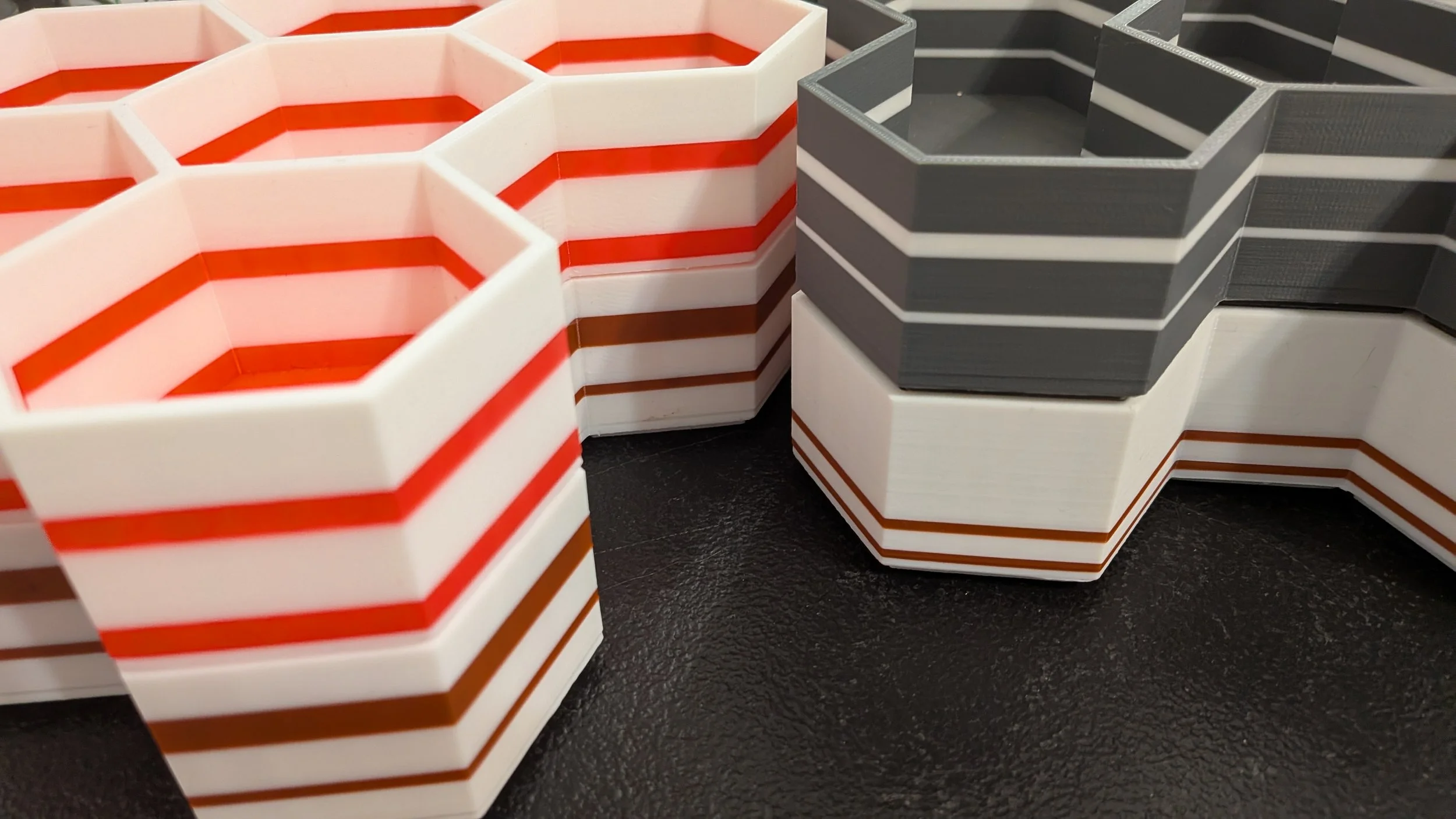
3D-Printed Hexagonal Storage Bins with Colorful Stripes
Slant3D has a video that shows numerous real-world examples of how to make sure your prints work regardless of filament type or machine. He uses technical and engineering solutions, such as changing the shape of a rectangle to a sort of star, or chamfering edges.
I’ve been doing some of the techniques he presented like slightly rounding parts, but for aesthetic reasons; I had noticed them fitting better.
It was neat finding something in there that I’d tumbled onto myself, but the rest of the video was eye-opening. I want to describe all the things I saw there, but there was simply so much information packed into easily digestible bits that I couldn’t begin to do it justice.
Something important I learned from this video: Not all printers will print the same design the same way. Even switching filament type or color can cause the same exact model to print slightly differently!
Understanding this helped me realize that fit isn’t just about the model itself. A lot depends on the printer and the filament, even when everything else stays the same.
The Need For Testing
I love the look of multi-color prints and plan to do more of them. Sometimes the filament that I switch to mid-print is one that seems to be slightly narrower. These beauties would be even better if the filament colors matched in specs post-print. How can I tell how my printers are going to treat the different filaments?
Creating a test to find out how different filaments handle a series of pegs and holes might be one way. I’ll do the test using the same holes, but pegs made on a different printer, to see how different things are from one to the next, using two different filaments.
The experiment ended up taking a lot of space, so I continued it in part two.
Bibliography
How to Design a Print with Perfect Tolerance EVERY Time
Slant3D
21 July 2025
Sevens, Ryan and Mroncz, Nikolaus
3D Printing Tolerances: What to Expect from each Process
Xometry
15 April 2025