PLA, PETG, and ABS: Which filament type do you need for your 3D Print?
Because one of my recent prints was going to use a lot of filament, it was suggested that I use a cheaper filament. The conversation went something like this:
“Cheaper filament? If we can use cheaper filament why do we ever use the more expensive stuff?”
“Because the quality isn’t as good.”
A pause while I considered this new information. Filament quality can be different? The rolls look basically the same to me, but for the color. Clearly I was missing some important knowledge.
“How are types of filament different? And what makes this one so bad?”
“Some filaments have additives that make them print faster because they cool faster. Some printers are made for high-speed printing, including one of ours. The cheaper filament lacks the additive, so it needs a slower print speed.”
“Okay.”
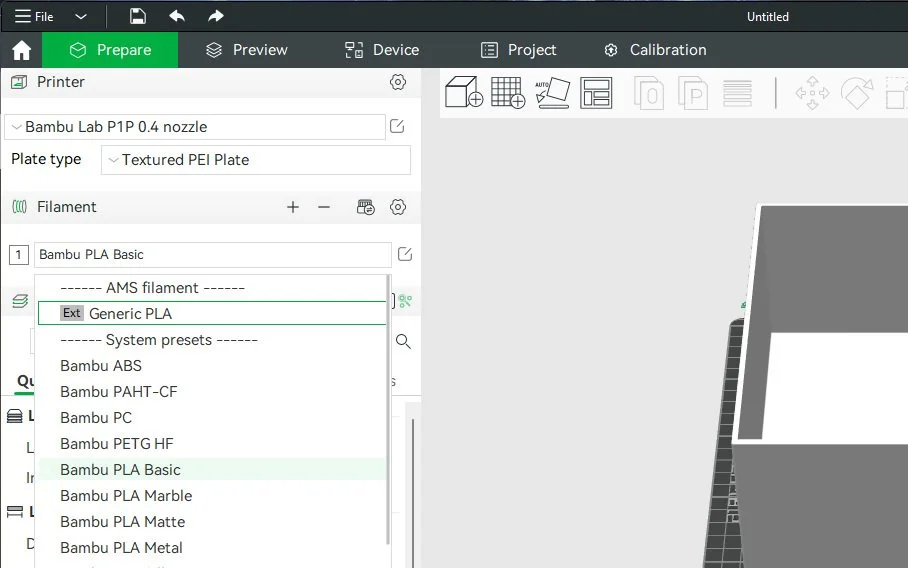
Filament Settings in Bambu Studio
We use the generic PLA setting for PLA filament that isn’t rated for high speed.
We then explored the settings menu on the printer. There was one called ‘Generic PLA’, and that was the one we needed. The setting change caused the software to estimate the print time to be significantly higher. Due to the use of cheaper PLA, the cost of the finished product was considerably lower.
There was concern that the filament might be too brittle; happily, it ended up working just fine.
The subject was not forgotten, however - I remained intensely curious about the different filament types and their optimal settings. Today I’m exploring common 3D printing filament types, including PLA, ABS, and PETG, and how their properties affect print quality and printer settings.
I first went to Bambu Lab Wiki, where I discovered a beginner’s guide to filament. It started out with something called FDM, right there in the title. The VERY FIRST WORD in the title, and I’m already feeling out of my depth. What is FDM, and why is it listed in this guide? I turned to Google’s AI Overview to find out.
FDM stands for Fused Deposition Modeling, and it refers to this method of 3D printing: layer by layer of extruded melted plastic that fuses together as it cools. Okay, good. Back to the FDM 3D Printing Filament Guide for Beginners, sourced below. According to it, there are three main types of filament. I listed them out and began to research: here are the results:
PLA: Polylactic Acid
PLA is the type of filament recommended for beginners because it has a low melting point and doesn’t require a heated bed. But why do those things matter?
A higher melting point grants better adhesion because the plastic is better able to stick to itself. If the melting point is too high, however, the plastic will be too liquid when it comes out, causing stringy bits to drip along.
The lower melting point trades adhesion for simplicity, as best as I can tell. A small amount of detail gets lost in the print because the plastic doesn’t stay melted long enough to bond as well. At the same time, products made using the lower melting point are more brittle. On the positive side, using a lower melting point adds control to the print process by requiring less heat to warm it, allowing faster warming and cooling, and lowering the risk of clogging.
Having a warm print bed can help with adhesion. It is necessary for types of filament that have a high melting point because the filament needs to stay warm and soft long enough for the subsequent layers to bond with it. PLA doesn’t need the warm bed due to its low print temperature, though the bed does help.
This type of filament is also more environmentally friendly than many other types of filament, a particular consideration of mine. As an aside, one of the things I would very much like to do is get a plastic chipper and some kind of melty technological wonder (I feel another article coming on!) so that I can recycle the plastic waste. The fumes are also low-toxicity, not non-toxic like I originally thought. They are, however, safer than many other filaments. This does not mean they are safe, please use good ventilation!
The quality of PLA can vary — the cheap stuff that I was using had a melting point on the low end, so wasn’t guaranteed to have as much cohesion. But what other kinds are there? Answer: there are as many types as there are needs!
There is PLA filament made to withstand higher temps, to be tougher, to resemble wood, metal, or numerous other textures, to be soft and flexible, to change color, glow, or even conduct electricity. PLA filament comes in numerous colors, is made of many different materials, and is sourced from different places.
One way to optimize a print is to find the best temperature for any particular type of filament. This is done with something called a temperature tower, which is a fancified tower built from blocks that are printed at incrementally higher temperatures each level.
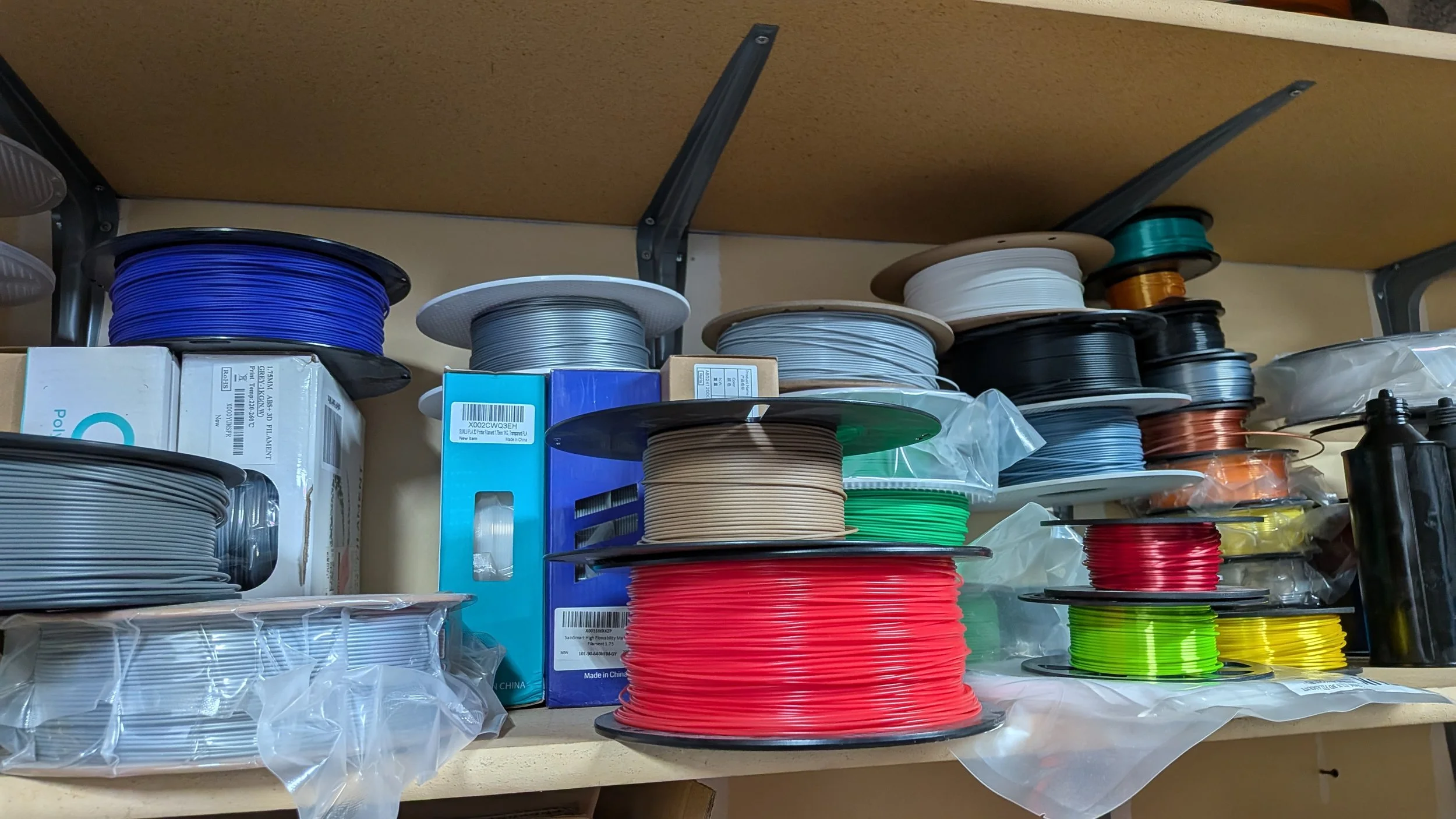
A variety of PLA filament textures and colors, with some PETG mixed in (probably)
ABS: Acrylonitrile Butadiene Styrene
Another type of printer filament is ABS. It requires a high temperature and a hot bed and is apparently prone to warping. This type of filament also has toxic fumes. The reason people still use it is because it can make high-quality prints. ABS models are sturdier than those made from most PLA.
According to the Bambu Lab Wiki, ABS requires more skill to use properly.
PETG: Polyethylene Terephthalate Glycol
A material that combines the benefits of both ABS and PLA, PETG is another desirable filament choice for beginners. It’s heat-resistant like ABS, is strong, and has good adhesion. It is often printed more slowly because it’s prone to stringing, and has a slightly rougher finish than the other two types.
Bibliography
Ding, Dora
FDM 3D Printing Filament Guide for Beginners
Bambu Lab Wiki
28 May 2024
O’Neill, Benedict
PLA Bed Temperature and Print Temperature Settings
Wevolver
29 November 2023
Dixit, Sachin
The Best PLA Filament Special Types
All3DP
22 August 2023
ChatGPT
“Why does a low melting temperature allow easier extrusion”