3D-Printing Children’s Toys: Safety Considerations Every Maker Should Know
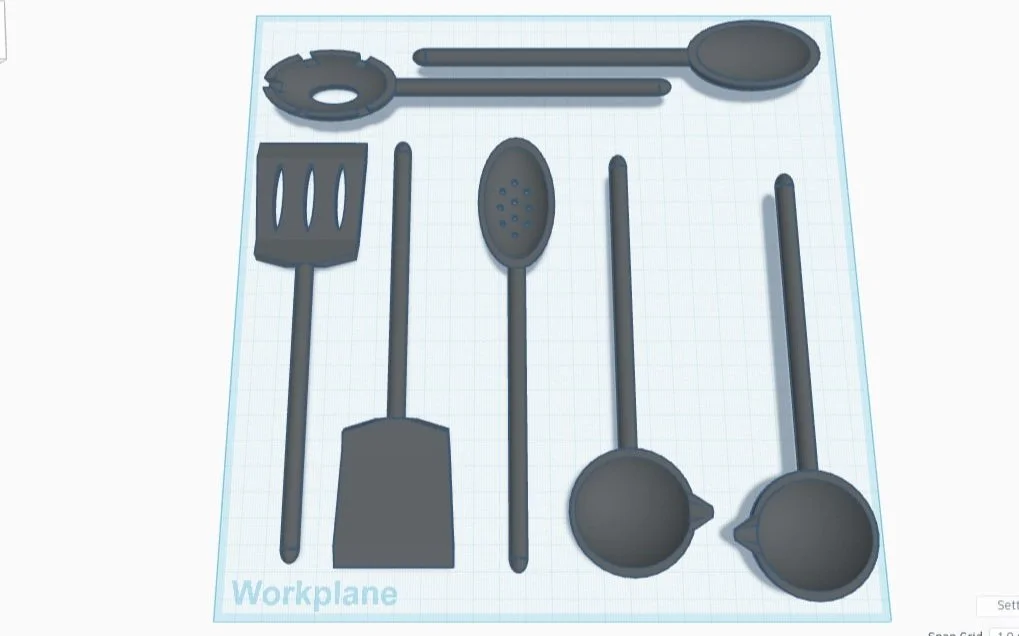
Kitchen Utensils
For ages 12 & up!
I made some very cute kitchen utensil models intended for a child’s play kitchen. I am fortunate enough to have a relative that works in a school. She told me that they were fine for her kids at home, though they would not be allowed in a classroom for safety reasons.
The kitchen utensils needed rounded handles, to prevent poking hazards.
The handles were long, and even when rounded they were still poking hazards for younger children.
The spatulas would be easier on the wrist if they had more of an angle to them.
In addition, it was suggested that I add a left-hand ladle to the set.
I went home and immediately made the necessary changes to make this set safe for smaller children. I made the ends even rounder, ensuring that they couldn’t accidentally scratch someone. I also angled the spatula, then created a ladle for left-handed people.
Before making more 3D-printed utensils for a play kitchen, I researched toy safety guidelines to make sure the designs were safe for children. Here is a summary of what I learned:
Chemical Leakage
While this set was made with non-toxic plastics, a person should be aware that some plastics can leach chemicals or other substances via skin contact. Please be careful with what you use if children are going to be handling these things!
Sharp Objects are Unwelcome
Kids can get cut on anything, but we can reduce their risks by giving them safer toys, ones with smooth edges and rounded ends.
Make Certain that Toys are Age Appropriate
Toddlers are likely to harm themselves if given even rounded things like drumsticks. They need items that they can’t stick into eyes, ears, or electrical sockets. Think bigger ends!
Look out for Choking Hazards!
Buttons, break-away pieces, or small balls that escape their settings, anything that is small enough to fit in a child’s mouth can become a choking hazard. Seattle Children’s Hospital says anything smaller than a toilet paper tube is a danger to children under 3!
Small Magnets are an Extra Danger
Even if a small magnet doesn’t get choked on, two or more can attract each other inside the body, causing serious injury or death.
I hadn’t planned on adding magnets to children’s toys, and now I definitely won’t.
Projectiles, Both Flying and Shooting
They can poke your eye out. Don’t use projectiles, but if you do, make them soft.
Cords and Strings
Less of a problem with 3D prints, I should think. It is on the site I cited, however, so I’m going to mention it anyway. The hospital suggests string no longer than 7 inches, though I am personally skeptical of anything that a kid can so much as wrap around a finger a couple of times.
Other Considerations
While looking into further child safety laws I learned that US federal law dictates that a person has to pay for third-party testing of toys that are available for children under age 12.
Food Safety
This wasn’t mentioned in the hospital list because that list wasn’t 3D-model specific. However there is some general knowledge that you should know: layer lines can harbor bacteria. Don’t put 3D-printed objects in your mouth. Some PLA could even have toxic additives, or ingredients that could make humans (or pets, I assume) sick. PLA is also not food-safe unless it says so on the box. I got all that information from a guide to food-safe printing, from FormLabs, cited below. The site also shares how to care for your food-safe prints so that they stay safe.
All that said, I’m not a lawyer, a social worker, a doctor, or any other type of professional with child safety credentials. Nothing I’ve written above is intended as legal or medical advice. If you’re a parent or some other entity responsible for small children, remember that nothing is 100% safe, and the best thing you can do is keep a close eye on your kids!
Bibliography
Seattle Children’s Hospital
Injury Prevention - Toy Safety
United States Consumer Product Safety Commission
Children’s Product Certificate
FormLabs
The Essential Guide to Food Safe 3D Printing: Regulations, Technologies, Materials, and More