3D Printing Simple Machines (Lever)
Lever
When I think of a lever, I think of teeter-totters and baking scales. A lever is a bar with a fixed hinge or fulcrum, and it can either be used as a force multiplier or to change the direction of force.
In the case of a teeter-totter, children sit on either end of a lever that’s balanced on a fulcrum. Kids would take turns pushing up with their legs and making their end of the lever rise, with them sitting on it! In the meanwhile, the other child would relax their legs and let the lever fall on their end. The children took turns changing the direction of force.
With a baking scale, one puts pre-measured weights on one side of the fulcrum, then adds ingredients to the other side, an equal distance away from the fulcrum, until the lever is flat. The evenness means that the weight, or amount of force on each side of the fulcrum, is equal.
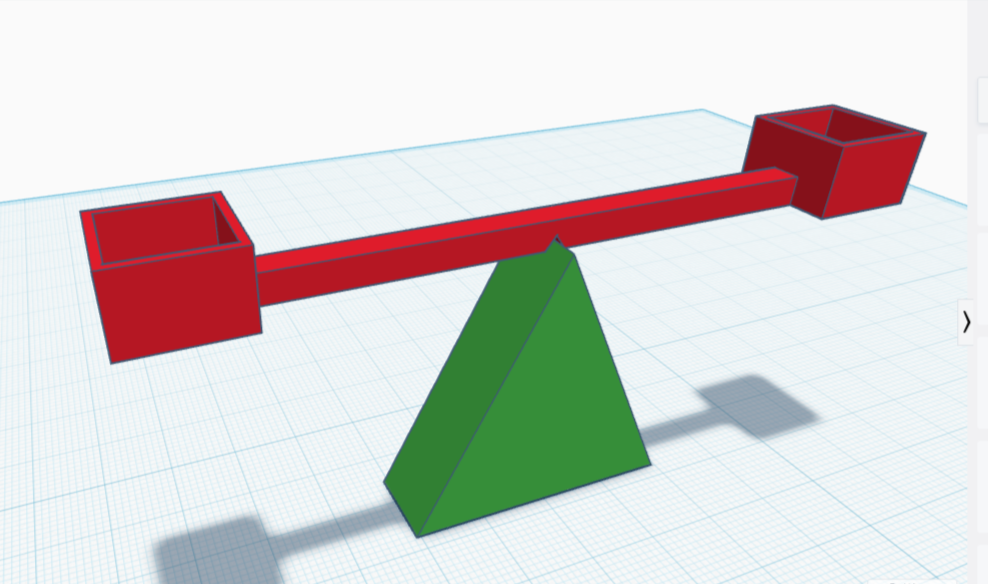
A Bar and Fulcrum
The bar and fulcrum that make up this lever depend on equal and opposing force to compare weight.
I thought it might be fun to test out my very own balancing scale! A triangle base made a fine fulcrum. I drafted a red bar and added two cube-shaped cups to either end, then added a wedge-shaped dent in the bottom center for the bar to rest on.
Next, I got out a couple of different types of lentils. I first put a single black lentil into one cup, then added orange ones until they weighed the same, a tricky feat given the shape of the cups.
Heaps of lentils tended to congregate in corners, throwing off the balance depending on which way the group slid. The positioning of the single black lentil had a similar effect, in that if it was all the way to one side it disproportionately affected the cup. I suspect this is why scales are slightly rounded: so that the weight consistently and evenly spreads in the center at the bottom. If I make something like this again, it will have rounded cups!
Despite the sliding, I tried to keep the piles centered so as to get as even a weighing as possible. The end result: 9 orange lentils to 1 black. Whoa.
I then tried it again with green and black ones. This was harder due to the size: the small size of the orange ones meant each one alone barely nudged the bar. For those it was easy to know when to stop. Here, I put a single black lentil in one cup, but three green lentils on the other side weren’t enough to move the bar, while four sent it plunging down. I couldn’t very well measure three and a half lentils! I solved this issue by adding another black lentil, then green ones until it balanced again. It takes seven green lentils to equal the weight of two black ones.
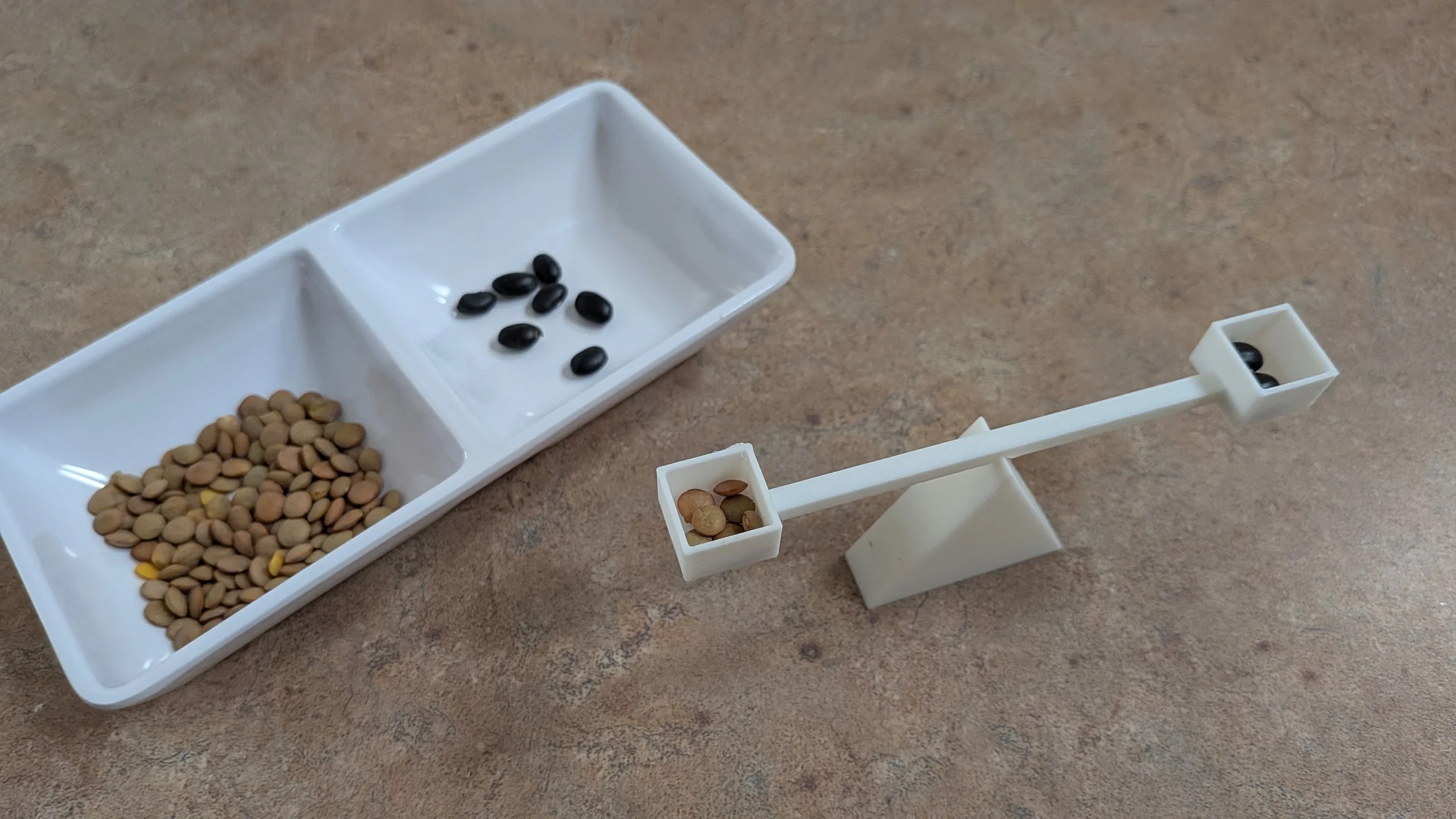
Balancing Lentils on a Scale!