3D Printing Simple Machines (Inclined Plane)
Inclined Plane
“Skate park” is what comes to mind when I try to think of real-life uses of inclined planes. I also think of cargo ramps and the matchbox car racetracks that work best draped over the arm of a couch. How accurate is any of this? Let’s find out! I turned to Wikipedia for some answers.
An inclined plane, also known as a ‘ramp’, is a flat surface tilted at an angle so that one end is higher than the other. It’s used to move heavy objects by trading force for distance, meaning the object has to travel farther but is easier to move.
According to Wikipedia, it was the last of the six basic machines to be recognized as such. Wiki also suggests that the reasons for this late discovery are twofold: the device itself doesn’t move, and also because inclined planes are naturally found in the slopes of hills.
I think that a typical phone stand is an inclined plane and not a wedge, even though it’s back and base together form a wedge shape. It doesn’t seem to be wedging anything.
I tried to find sources to back that up, but alas info on cellphone stands as basic machines was rather scant. On turning to ChatGPT, I confirmed that it is indeed an inclined plane, basically because it supports an object on a slope. Good enough then, I’m off to design a 3D printed cellphone stand.
I got out my trusty sketchpad, found one of the few remaining blank pages that didn’t also have either coffee stains or smudged graphite, and started on a technical drawing. Quarter the paper, check. Mark Top, Front, and Side, check. Decide on a scale, check. Fill in the title block, check. So far so good. Then I got to the TOP section. I know how big my phone is, 6” x 3”, and 7/16” thick. I have no idea how big a triangle to make if my phone is the surface area of one side. Eeep! I turned to Google AI Overview for help.
First off, it suggested somewhere between 60 and 85 degrees as a standard tilt for conference calling, instead of the 45 degrees I had been thinking of. Good to know! I then asked for the size of the base and the total height of the triangle I needed, based on my phone dimensions and the need for a 60 degree tilt. Can’t finish the drawings without proper dimensions!
Answer
The base length of your stand should be 3.125 inches and the total vertical height should be 5.41 inches.
I filled in the drawings, then went to Tinkercad and banged out the design, which I will share here. I will be printing it once I add some fancy decorations to fill in the triangle frames on either side. I’m thinking lace or flowers. Whichever I choose, it will be something that helps strengthen the unit overall in the form of additional support, as well as makes it pretty.
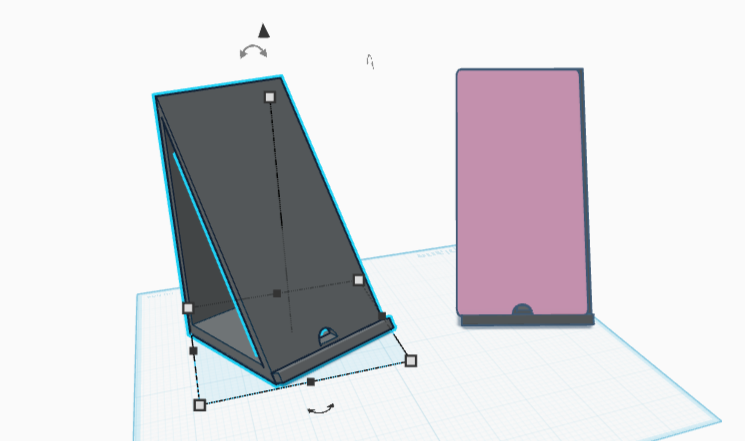
Two cellphone stands, one with a mock cellphone on it.
Summary
The pulley, screw, lever, wedge, wheel and axle, and inclined plane are simple machines that appear in everyday objects—from bottle caps to phone stands—and I enjoyed designing 3D-printed examples and experiments with them.
As for the inclined plane vs wedge, I am having a little conversation about it with ChatGPT. I thought the difference was that a plane doesn’t move. Nope, technically inaccurate. Is the difference that a plane just holds a thing, instead of keeping it from moving, or moving it? Still no dice.
Chat then explained it to me like so: a wedge is essentially two inclined planes back-to-back. Aside from that, the difference is in how they are used. An inclined plane makes it easier to move an object by spreading the work of moving an object over a longer distance. A wedge is pushed into something to redirect force so that it splits, lifts, or holds an object.
I am summarizing what ChatGPT said about the differences between plane and wedge because I kept getting it wrong and it wanted to help. It actually included a long and rather technical paragraph that it claimed fit my tone. Honestly I appreciate the editing it does, amazing, but it trying to write a paragraph for me is not gonna happen, also it’s creepy. So you get the short version :)